Member and shared parameters
Review experiment-specific values alongside any parameters shared across the result.
 FT-ITC Analysis
Multiple-experiment analysis
FT-ITC Analysis fits related experiments in one combined analysis, with global constraints and advanced temperature, salt and proton-linkage views when supported by the data.
The analysis result
Move from individual fits to a result that makes the relationship between experiments legible. Review shared and experiment-specific parameters, fit quality and residuals without losing the underlying datasets.
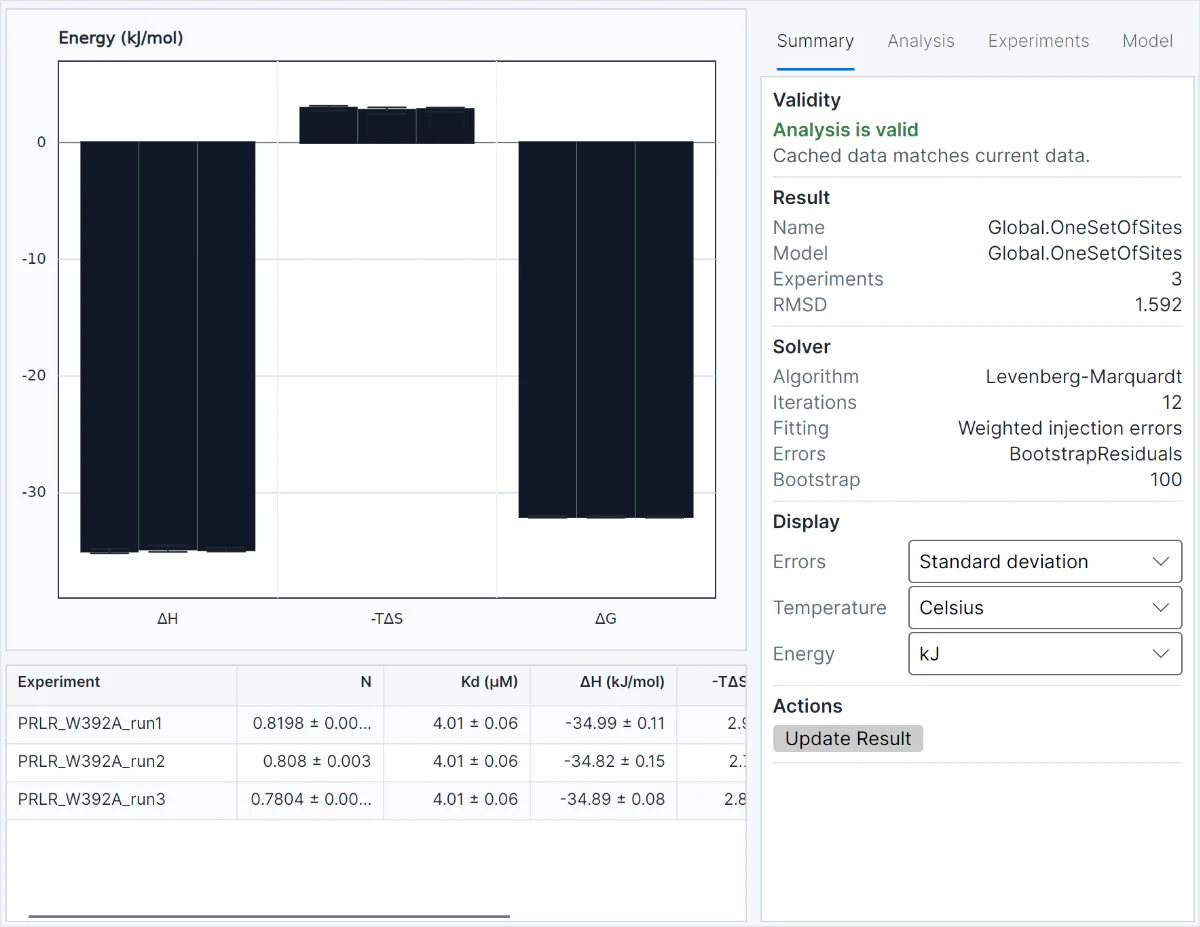
Review experiment-specific values alongside any parameters shared across the result.
Examine temperature-dependent behaviour and derived relationships such as ΔCp.
Keep the experiments, assumptions and model choices linked to the final result so you can see how each conclusion was reached.
Investigate temperature dependence, salt effects and proton linkage when the model, experiment series and metadata support them.
Multiple-experiment fitting
Analyse multiple isotherms in one combined result. Keep every parameter experiment-specific, or introduce shared and supported temperature-dependent relationships for a connected global optimization.
Bring at least two processed experiments into one analysis and one combined result.
Share selected parameters or connect them through physical relationships while retaining experiment-level values where needed.
Read global parameters together with individual isotherms, residuals and the experiments contributing to the fit.
Advanced analyses
Carefully designed experiment series can extend the interpretation beyond affinity and enthalpy while keeping the required conditions and assumptions explicit.
Temperature-dependent binding measurements can reveal how enthalpy and entropy change across a series. FT-ITC Analysis brings these results together to examine the conformational entropy and structural change associated with binding.
The workflow is based on the Spolar-Record approach: it uses the temperature dependence of binding thermodynamics, including heat-capacity change, to provide a literature-led view of coupled folding and binding. It is a core advanced feature, but its conclusions should always be read with the experimental design and assumptions in view.
Compare a series across ionic strengths to evaluate salt effects on binding and estimate the selected model's extrapolated dissociation constant at zero ionic strength.
Compare titrations performed in buffers with different protonation enthalpies to investigate proton-linked effects on binding.
Further reading
Read the underlying methods and review the assumptions before drawing specialised conclusions.