
Tools
Design simulated titrations, subtract buffer controls, and merge standard or back-mixed tandem experiments.
Last verified:
The Tools menu contains Experiment Designer..., Buffer Subtraction..., and Experiment Merger.... They have different output lifecycles: Experiment Designer keeps simulation and fitting inside its window, Buffer Subtraction stores a correction on target experiments, and Experiment Merger creates a new processed Experiment Data item. Source and target selection uses the project state described in Workspace.
Experiment Designer
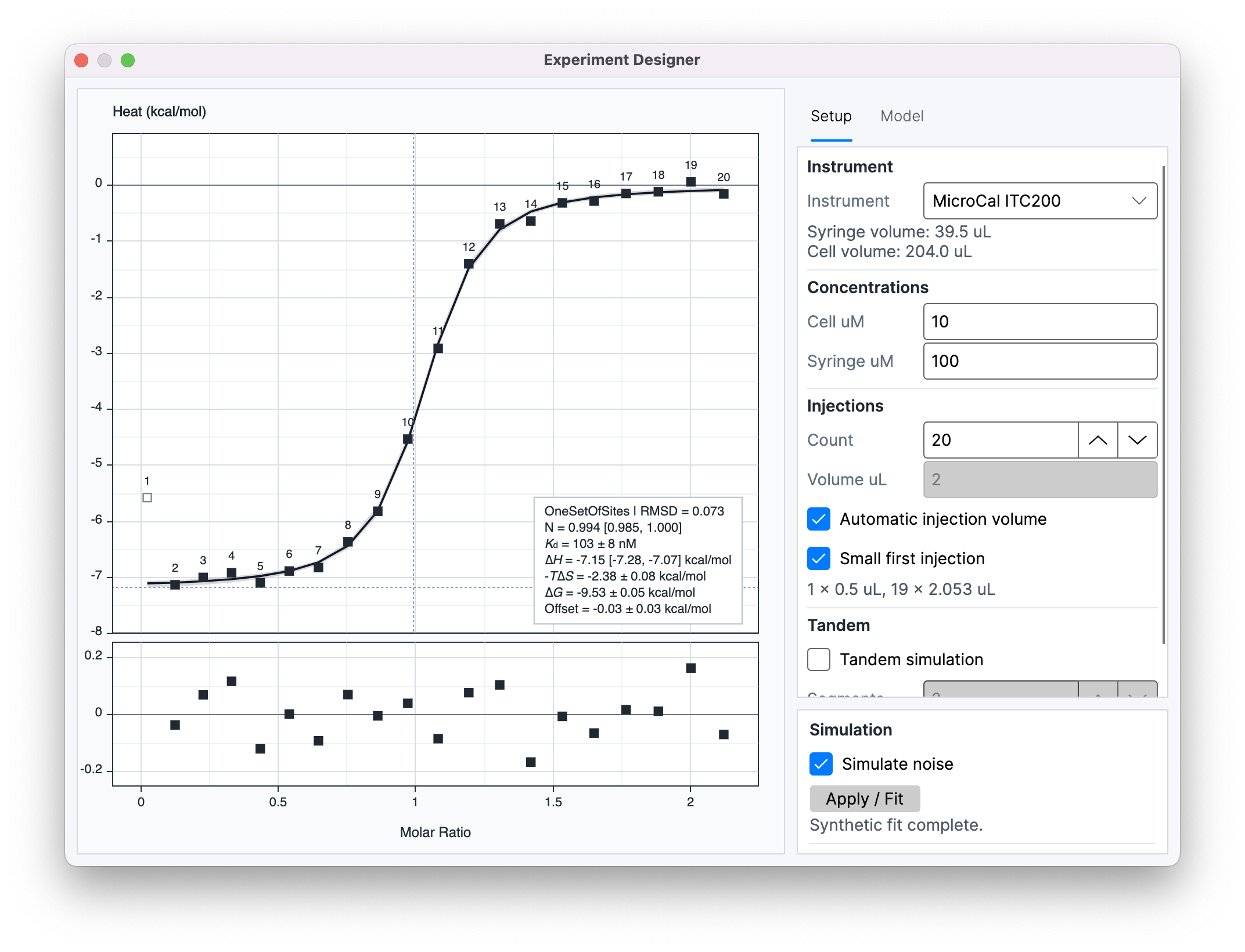
Experiment Designer... creates a synthetic titration from instrument, concentration, injection, and model parameters. The graph updates as the design changes. The designer does not add the synthetic experiment or its fit as a project item.
Setup and model controls
The Setup tab contains Instrument, Cell uM, Syringe uM, injection Count, and Volume uL. Count and volume define the injection schedule. Automatic injection volume derives the injection volume from the selected instrument’s standard syringe volume and injection count. Small first injection gives the first injection of each load a smaller volume and marks it excluded. Tandem simulation creates consecutive loads, with Segments defining their count and the designer’s tandem back-mixing model.
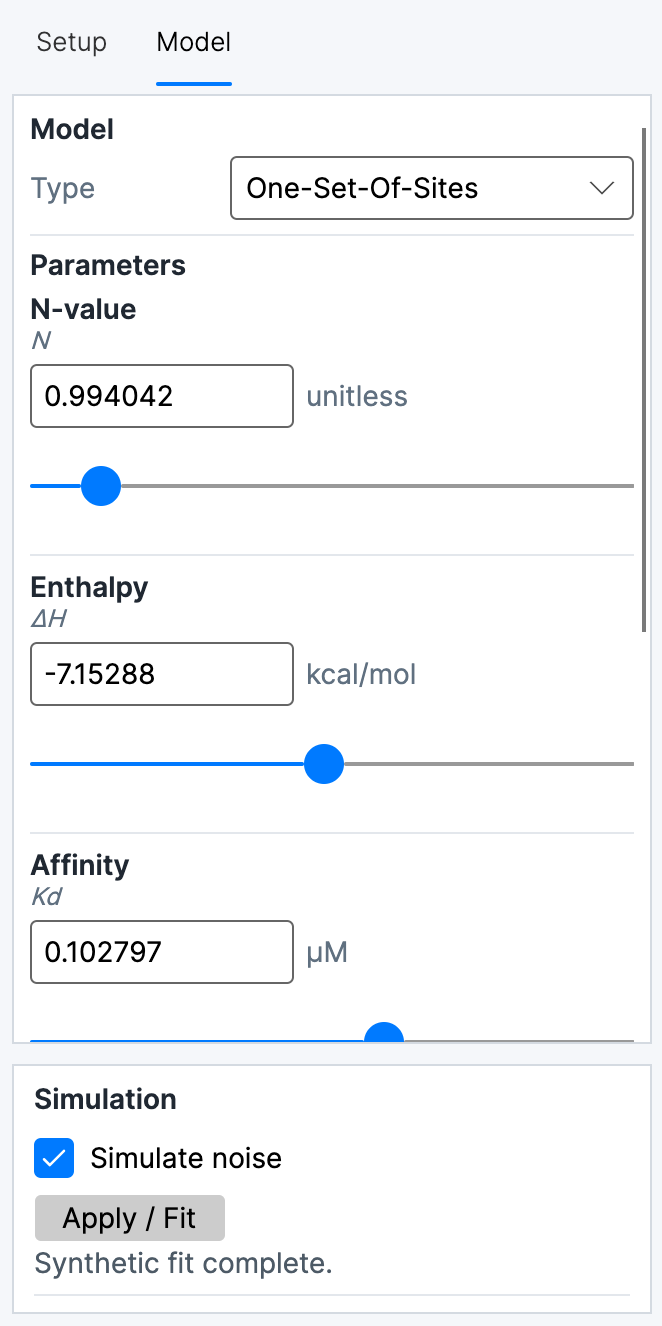
The Model tab contains Type, exposed model Parameters, and model-specific Options. Simulate noise adds synthetic measurement noise. Apply / Fit fits the synthetic data in the designer window and reports the fit on its graph; neither the simulation nor this fit becomes an Analysis Result or Experiment Data entry.
Buffer Subtraction
Buffer Subtraction... models background heat from one processed reference experiment and applies the resulting correction to one or more target experiments. The reference selector shows experiment metadata and a Processed or Not yet processed status. The target list excludes the selected reference and supports multiple targets. A processed reference is required; its processing state is described in Processing.
The Method selector contains Matched, Linear, and Exp. decay:
- Matched evaluates the reference heat at each target injection number, using nearby included reference injections when the matching injection is unavailable.
- Linear fits a line through valid, included reference injections and evaluates it across target injections.
- Exp. decay fits an exponential-decay model through valid, included reference injections when enough points are available.
The preview graph shows reference and target heats and the selected subtraction model. Reference-point inclusion changes the points available to the fitted methods. Focus Y axis on buffer data changes only the preview range. A continuous model line appears for Linear and Exp. decay; Matched is represented by injection-level reference values.
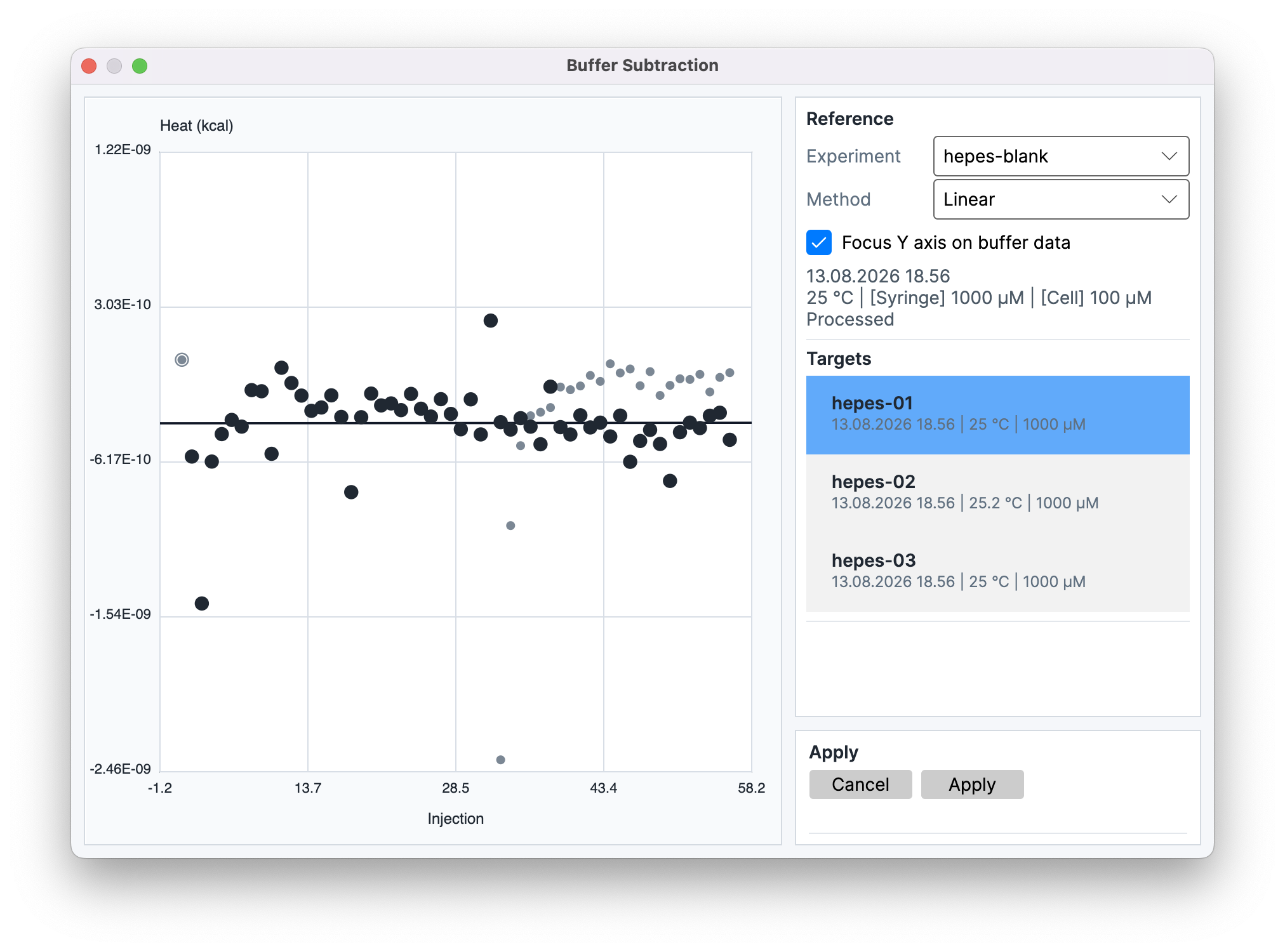
Apply stores the reference and method on each target. The corrected heats are then used by downstream fitting and export while the original integrated heats remain unchanged. The reference Experiment Data becomes inactive. Changes in its processing or injection inclusion update the target corrections. The subtraction is project data and can affect the validity of dependent results.
Experiment Merger
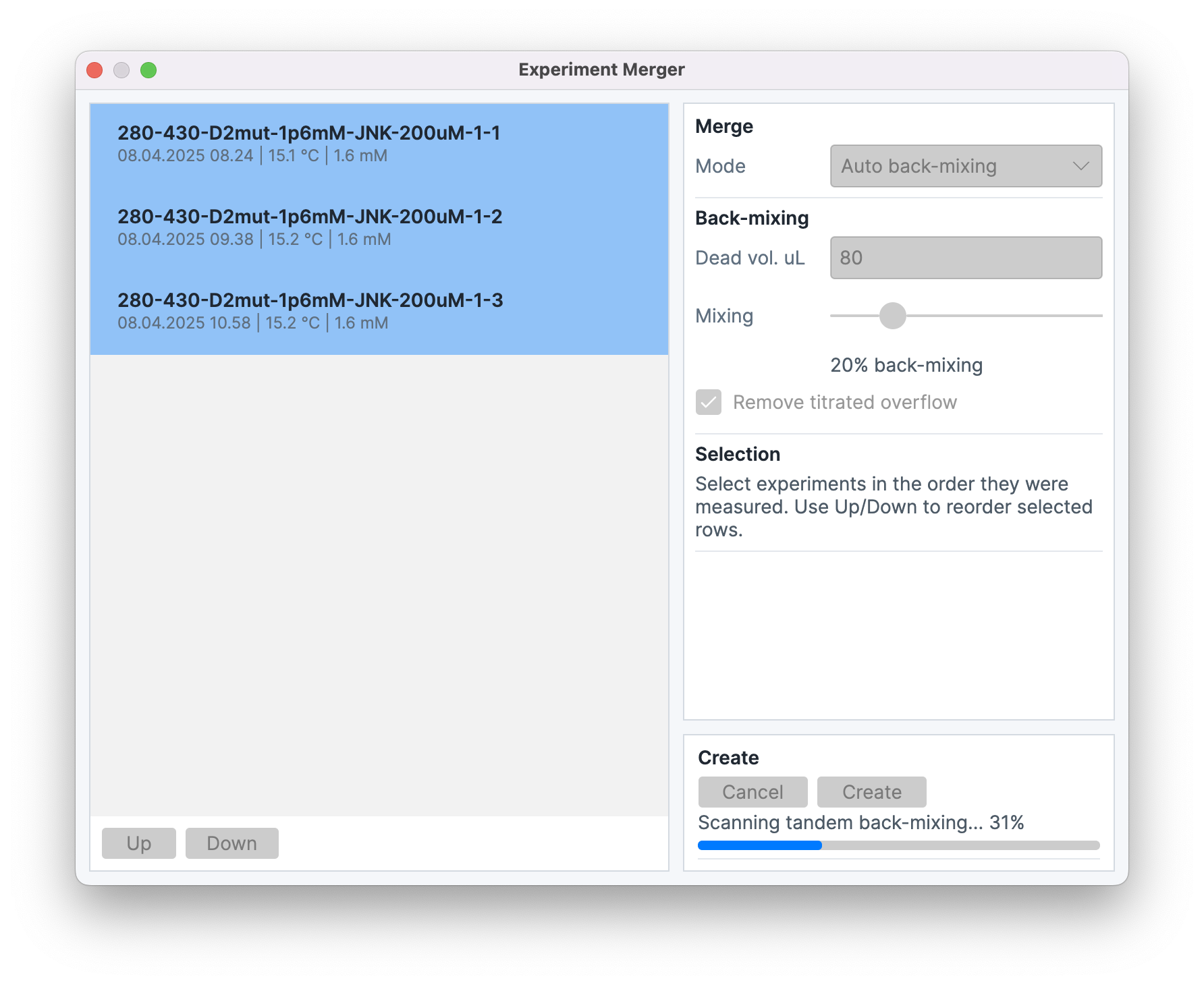
Experiment Merger... joins two or more eligible thermogram experiments from consecutive segments of a tandem titration. The source list contains thermograms that are not already tandem experiments. Selection order defines segment order; Up and Down reorder selected rows.
The merge Mode selector contains:
- Simple tandem, which concatenates the segments using the standard concentration progression without a user-selected back-mixing correction.
- Fixed back-mixing, which applies one configured mixing fraction at every segment transition. With three or four selected experiments, you can instead set an individual fraction for each reload.
- Auto back-mixing, which scans for a transition mixing fraction and is available for up to five source experiments. Its initial grid adapts to the number of sources (2%, 5%, 10%, and 20% steps for two through five experiments), followed by local pattern searches at smaller steps.
Back-mixing controls include Dead vol. uL, the Mixing fraction, and Remove titrated overflow. Dead volume represents the filling-stem or overflow volume above the active cell volume. The overflow control records whether titrated overflow was removed between segments. In Fixed mode, the shared slider supplies the fraction. With three or four experiments selected, enable the individual-fractions option to set Reload 1, Reload 2, and, for four experiments, Reload 3 separately. In Auto mode, the scanner determines the transition values.
Create produces a new processed Experiment Data item. Its thermogram samples are time-shifted and concatenated, its injection sequence retains segment boundaries, and its segment metadata stores the calculated starting active-cell and active-titrant concentrations. The merged item’s comments record the selected tandem mode and back-mixing parameters. Source experiments remain separate and are not changed by creation; the new item is marked as a tandem experiment and is not eligible as a later merger source. It is a snapshot and does not update if its source experiments are subsequently edited. The resulting item can be fitted through Analyze Data.
Tandem injection-displacement correction
The dilution-method preference selects either the MicroCal or Exponential injection-displacement correction for both simple concatenation and back-mixing modes. Let u be cumulative injected volume divided by active cell volume. The ordinary no-back-mixing reference curves are
AM(u) = (1 − u/2) / (1 + u/2)
BM(u) = u(1 − u/2)
for MicroCal, and
AE(u) = exp(−u)
BE(u) = 1 − exp(−u)
for the exponential method. A is the retained fraction of the original cell material and B is the cell concentration of syringe material relative to its syringe concentration.
For an injection advancing the history from u0 to u1, define
r = A(u1) / A(u0)
M1 = rM0
L1 = rL0 + Cs[B(u1) − rB(u0)]
Here M and L are the current active-cell concentrations and Cs is the syringe concentration. After a segment transition, the concentrations produced by the active/dead-volume mixing model are authoritative, while u retains the uninterrupted injection history. With no back-mixing, repeated application telescopes exactly to the ordinary reference curves.
The MicroCal reference curves are from Malvern Instruments, MicroCal ITC Analysis Software Using Origin User Manual, MAN0577-02-EN-00 (20 May 2015), section 12.3.1, equations 2 and 4. The arbitrary-state transition above is an FT-ITC Analysis extension derived from those curves; the Malvern manual does not specify a tandem back-mixing transition. Because AM(2) = 0, stateful MicroCal advancement stops before cumulative injected volume reaches twice the active cell volume: a later transition would divide by zero, and extending the approximation beyond that point would give negative retained concentrations. The exponential method has no corresponding finite-volume boundary.